
Mount Koya — Japan's Sacred Mountain
Hidden deep within the cedar-covered mountains of Wakayama Prefecture lies one of Japan's most extraordinary spiritual destinations. Known as Mount Koya, or Koyasan, this vast monastic settlement has been a place of pilgrimage, meditation, and religious study for more than twelve centuries.
Unlike many of Japan's famous temples, Koyasan is not simply a historic monument. It is a living religious community where monks continue to practice the teachings of Shingon Buddhism, morning prayers echo through temple halls, and centuries-old traditions remain an essential part of everyday life.
Recognized as a UNESCO World Heritage Site as part of the Sacred Sites and Pilgrimage Routes in the Kii Mountain Range, Mount Koya attracts visitors from around the world. Some come for its remarkable temples, others for its breathtaking cedar forests or the opportunity to spend the night in a Buddhist monastery. Yet nearly everyone leaves with the same impression: Koyasan is unlike anywhere else in Japan.
More than a destination, it is an experience—one that invites visitors to slow down, reflect, and discover a different side of Japanese culture.
The Origins of Mount Koya
The story of Mount Koya begins with one of the most influential figures in Japanese religious history: Kukai, better known by his posthumous name Kobo Daishi.
Born in 774 on the island of Shikoku, Kukai showed exceptional intellectual curiosity from an early age. Although he initially studied Confucian philosophy, he soon turned toward Buddhism, seeking a deeper understanding of spirituality and the nature of existence.
At the beginning of the ninth century, he traveled to Tang Dynasty China, then the cultural and religious center of East Asia. There, he studied Esoteric Buddhism, a highly symbolic form of Buddhist practice based on rituals, meditation, sacred texts, and elaborate mandalas representing the universe.
After only two years of study, Kukai returned to Japan carrying scriptures, artworks, ritual objects, and knowledge that would transform Japanese Buddhism forever.
In 816, Emperor Saga granted him permission to establish a secluded religious center high in the mountains of present-day Wakayama Prefecture.
According to tradition, Kukai had long searched for the ideal place to build his monastery. One legend tells that before leaving China, he threw his vajra, a sacred Buddhist ritual object, into the sky while praying that it would guide him to the perfect location. Years later, while exploring the mountains of Kii, he is said to have discovered the vajra hanging from the branches of a pine tree, marking the place where Mount Koya now stands.
Whether historical fact or legend, the story reflects the profound spiritual significance that believers continue to associate with the mountain today.
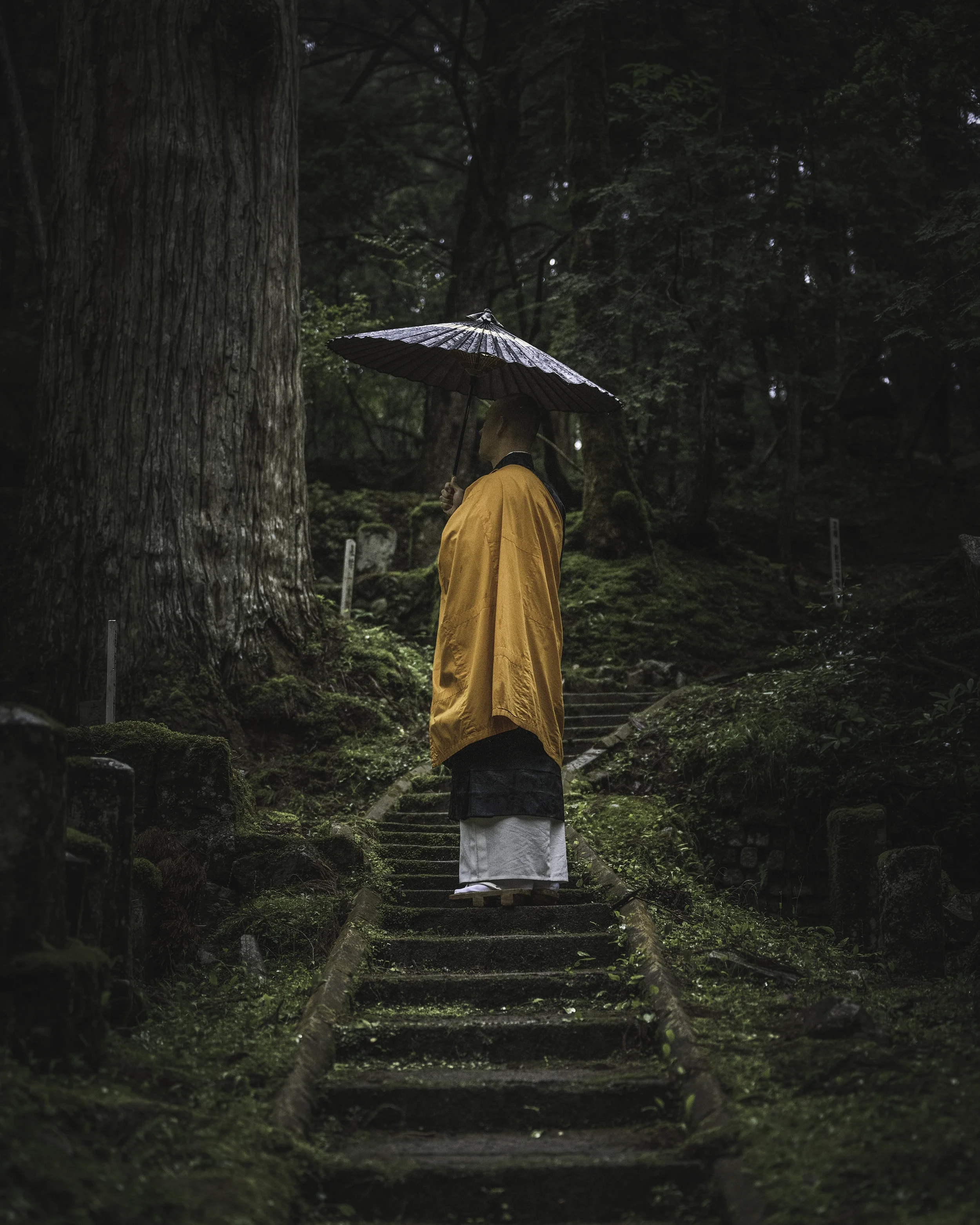
The Birthplace of Shingon Buddhism
Mount Koya soon became the center of Shingon Buddhism, one of Japan's major Buddhist schools.
Unlike Zen Buddhism, which emphasizes simplicity and silent meditation, Shingon focuses on ritual, symbolism, chanting, sacred geometry, and meditation practices intended to help practitioners experience enlightenment during their lifetime.
At the heart of these teachings lies the belief that the universe itself is an expression of the cosmic Buddha, known as Dainichi Nyorai (Mahavairocana).
Architecture, sculpture, paintings, ceremonies, and even the layout of the temples all reflect this symbolic vision of the universe.
Over the centuries, Mount Koya grew into an immense religious complex composed of more than one hundred temples, monasteries, pagodas, and meditation halls.
Thousands of monks studied here, while pilgrims traveled across Japan to pay their respects to Kobo Daishi.
Today, around fifty temples still welcome visitors wishing to experience daily monastic life through overnight stays known as shukubo.
Okunoin — The Spiritual Heart of Koyasan
If there is one place that defines Mount Koya, it is Okunoin.
More than simply a cemetery, Okunoin is regarded as one of the holiest places in Japan.
The approach begins at Ichinohashi Bridge, where many pilgrims traditionally bow before entering the sacred grounds.
From here, a peaceful stone path stretches for nearly two kilometers beneath towering Japanese cedar trees, some more than five hundred years old.
Along the way stand over 200,000 tombstones, making Okunoin the largest cemetery in Japan.
Yet despite its immense size, the atmosphere is remarkably peaceful rather than somber.
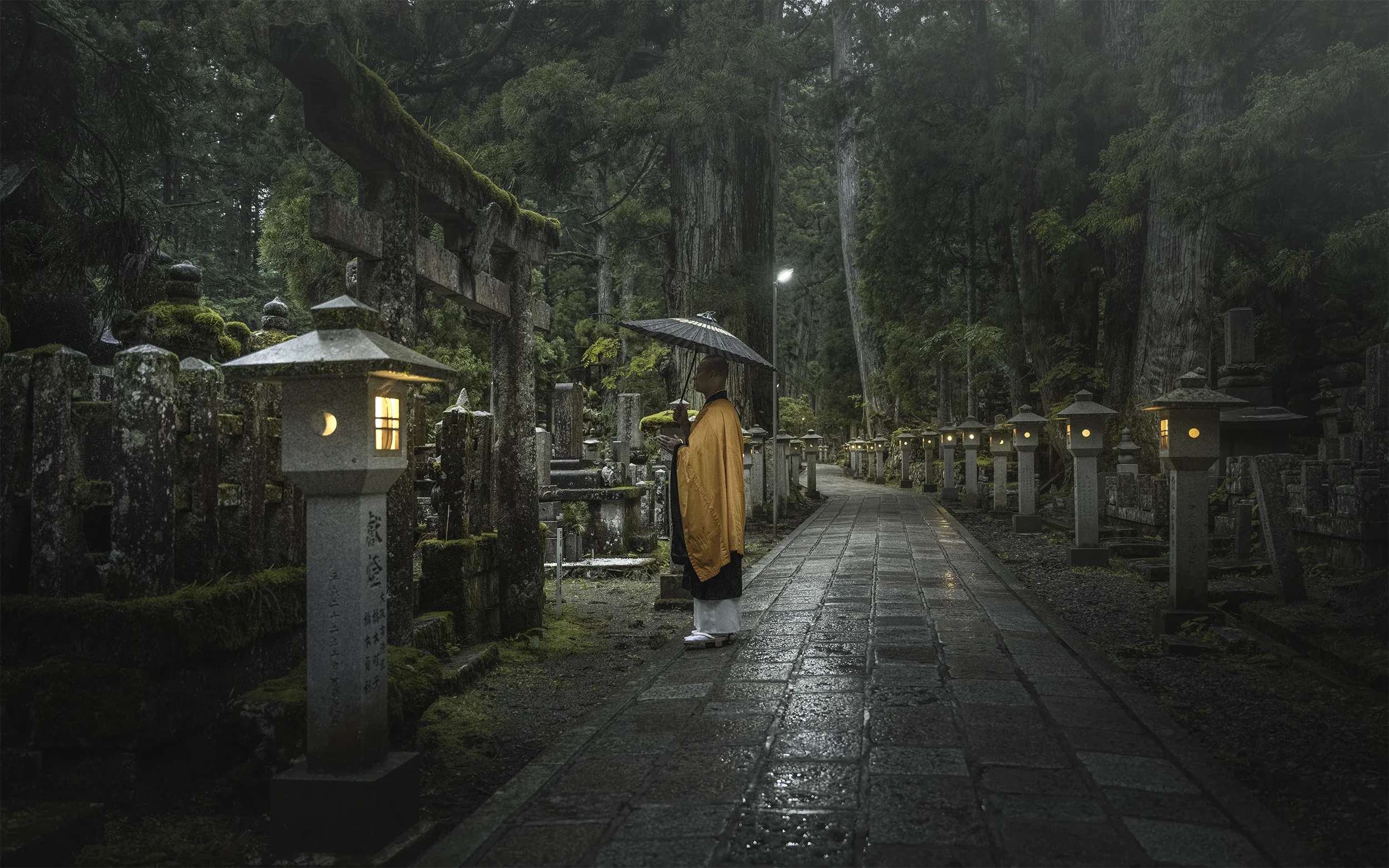
Stone lanterns, moss-covered monuments, weathered Jizo statues dressed with red bibs, and towering cedars create an almost timeless landscape where nature and spirituality seem inseparable.
Among those buried here are monks, samurai, feudal lords, poets, artists, politicians, and ordinary families.
Even some of Japan's largest modern companies maintain memorials within the cemetery, reflecting a long-standing tradition of seeking spiritual protection and blessings.
Walking through Okunoin is not simply a visit to a historical site.
It is an experience that encourages silence and contemplation.
The sound of birds replaces the noise of cities.
Sunlight filters gently through the cedar canopy.
The scent of damp earth and ancient wood fills the air.
Every step seems to carry visitors deeper into another world.
Kobo Daishi's Eternal Meditation
At the end of the cemetery lies the most sacred place on Mount Koya: the Gobyo, the mausoleum of Kobo Daishi.
According to Shingon belief, Kukai did not die in the conventional sense.
Instead, he entered eternal meditation, remaining spiritually alive while awaiting the arrival of the Future Buddha, Maitreya.
For this reason, monks continue to bring him meals twice every day, a ritual that has never ceased for more than twelve hundred years.
Photography is prohibited beyond Gobyobashi Bridge, the final bridge leading to the mausoleum.
Visitors are also asked to maintain silence and treat the area with the utmost respect.
Whether one shares these beliefs or not, the profound reverence surrounding the mausoleum is impossible to ignore.
Few places in Japan convey such a powerful sense of living spirituality.
Torodo — The Hall of Lanterns
Adjacent to the mausoleum stands Torodo, the Hall of Lanterns.
Inside, thousands of lanterns illuminate the dim interior with a warm golden glow.
Many of these lanterns have been donated by pilgrims over the centuries, while tradition holds that two of them have burned continuously for more than nine hundred years.
The soft light, the scent of incense, and the quiet prayers offered by monks create one of the most atmospheric spaces anywhere in Japan.
Unlike many religious buildings, Torodo feels less like a museum and more like an active place of devotion where ancient traditions continue uninterrupted.
Danjo Garan — The Birthplace of a Sacred City
While Okunoin represents the spiritual destination of every pilgrimage, Danjo Garan marks its beginning.
This vast temple complex was the first area established by Kukai after arriving on Mount Koya and remains the ceremonial heart of Shingon Buddhism.
According to tradition, Kukai envisioned the entire plateau as a giant mandala—a symbolic representation of the Buddhist universe.
Every building within Danjo Garan was positioned to reflect this spiritual vision.
The most striking structure is undoubtedly the Konpon Daito, an impressive vermilion pagoda rising nearly fifty meters above the surrounding forest.
Far more than a pagoda, it was conceived as a three-dimensional expression of Buddhist cosmology.
Inside, visitors find an extraordinary arrangement of statues and paintings centered around Dainichi Nyorai, surrounded by the Buddhas of the Four Directions.
Together, they represent the cosmic universe central to Shingon belief.
Nearby stands the Kondo, the principal hall where many of Koyasan's most important religious ceremonies continue to be held today.
Unlike the quiet atmosphere of Okunoin, Danjo Garan feels open and vibrant.
Its broad courtyards, elegant temple buildings, towering cedars, and vivid vermilion structures create one of the most beautiful religious landscapes in Japan.
Walking through the complex, it becomes easy to understand why Mount Koya has remained the spiritual center of Shingon Buddhism for more than twelve centuries.
Kongobuji — The Headquarters of Shingon Buddhism
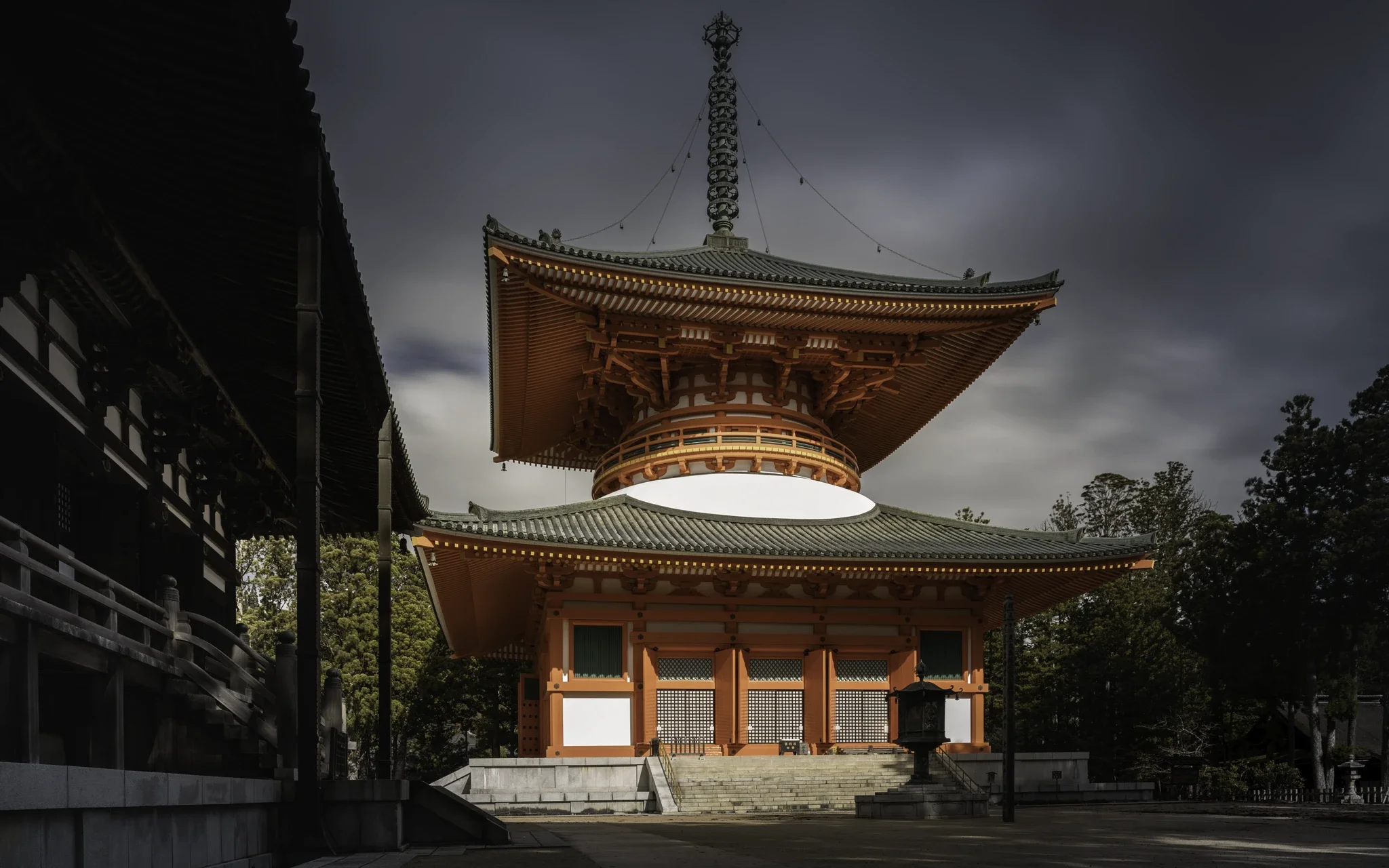
A short walk from Danjo Garan stands Kongobuji, the head temple of Shingon Buddhism and one of the most important religious buildings on Mount Koya.
Although the temple in its present form dates largely from the late sixteenth century, its significance extends far beyond its architecture. For centuries, Kongobuji has served as the administrative and spiritual center of the Shingon school, welcoming monks, pilgrims, and visitors from across Japan.
Its understated exterior reflects the simplicity often associated with Japanese religious architecture. Inside, however, visitors discover an extraordinary world of craftsmanship and symbolism.
Elegant sliding doors (fusuma) are decorated with large-scale paintings depicting cranes, pine trees, seasonal flowers, and scenes inspired by Chinese and Japanese traditions. These artworks are not merely decorative; they express harmony between nature, spirituality, and the changing seasons.
Tatami rooms open onto peaceful interior gardens where silence becomes almost tangible.
One of the highlights of Kongobuji is the Banryutei Rock Garden, completed in 1984. Covering more than 2,000 square meters, it is the largest dry rock garden in Japan.
Its carefully arranged granite stones represent a pair of dragons emerging from a sea of clouds, symbolizing strength, wisdom, and the protection of Buddhist teachings. Like many Japanese dry gardens, its meaning is intentionally open to interpretation, inviting quiet reflection rather than providing fixed answers.
Experiencing Life in a Shukubo
One of the most memorable ways to experience Mount Koya is by spending a night in a shukubo, or temple lodging.
Originally built to accommodate Buddhist pilgrims, these temple guesthouses now welcome travelers from around the world who wish to experience a slower and more contemplative rhythm of life.
Unlike a traditional hotel, a stay in a shukubo offers a glimpse into the daily routines of a working monastery.
Guests sleep on futons laid over tatami mats, enjoy peaceful temple gardens, and are encouraged to disconnect from the pace of modern life.
Before sunrise, the sound of temple bells echoes through the mountains.
Visitors who wish may attend the monks' morning prayers, where rhythmic chanting, incense, and centuries-old rituals create an atmosphere unlike any ordinary tourist experience.
Breakfast is equally memorable.
Meals consist of shojin ryori, traditional Buddhist vegetarian cuisine prepared without meat or fish.
Every ingredient is selected according to the principles of balance, seasonality, and respect for nature. While beautifully presented, the dishes also reflect the Buddhist ideals of simplicity and mindfulness.
Many visitors describe a night in a shukubo as one of the highlights of their journey through Japan—not because of luxury, but because of the rare opportunity to experience a living spiritual tradition.
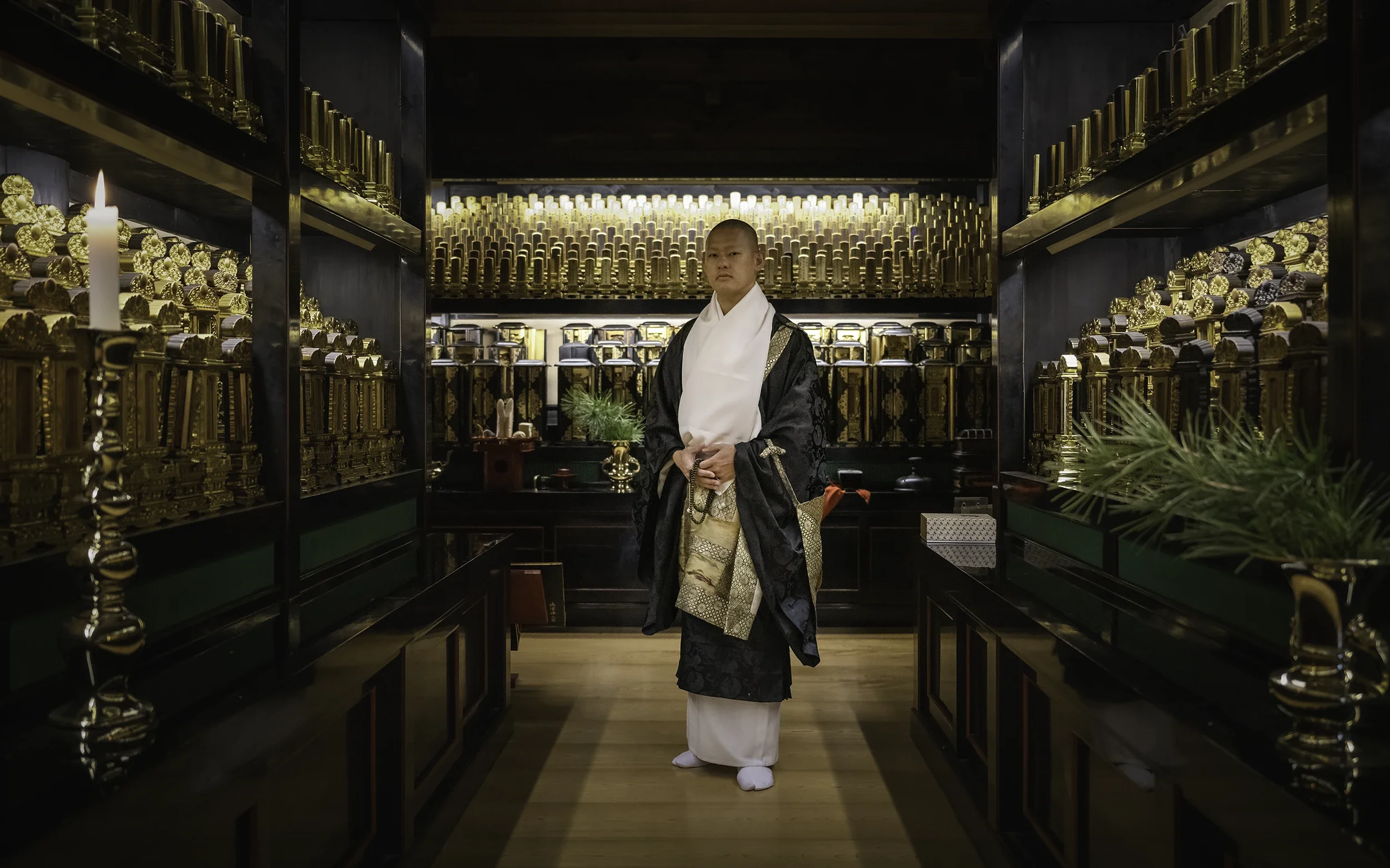
Walking Through the Sacred Forest
Perhaps the greatest beauty of Mount Koya lies not in any single temple, but in the atmosphere created by the mountain itself.
Throughout the day, mist drifts between towering cedar trees.
Ancient stone lanterns emerge from carpets of moss.
Small streams wind quietly through the forest before disappearing beneath wooden bridges.
Unlike many of Japan's most famous tourist destinations, Mount Koya encourages visitors to slow their pace.
There is no need to rush from one monument to another.
Instead, the mountain invites quiet observation.
A monk cycling between temples.
The sound of distant temple bells carried by the wind.
The scent of cedar after summer rain.
The soft light filtering through centuries-old trees.
These simple moments often become the memories visitors treasure most.
At dawn, the mountain feels almost timeless.
In the evening, as many day visitors leave, silence gradually returns to the temple streets.
It is during these quieter hours that Koyasan reveals its true character.
The Seasons of Mount Koya
Mount Koya offers a different experience throughout the year.
In spring, delicate cherry blossoms contrast beautifully with the dark wooden temples, while fresh mountain greenery transforms the surrounding forests.
Summer brings cool temperatures compared with nearby cities, making Koyasan a refreshing escape from the heat of Osaka or Kyoto.
Autumn is perhaps the most spectacular season. Brilliant red maples, golden ginkgo trees, and deep orange foliage surround the temples, creating some of the most beautiful landscapes in the Kansai region.
Winter offers an entirely different atmosphere.
Snow often blankets the cedar forest, temple roofs, and stone monuments, creating an almost silent landscape of remarkable beauty.
Although colder and quieter, winter is often considered one of the most magical times to experience Mount Koya.
Visiting Mount Koya
Despite its peaceful mountain setting, Mount Koya is surprisingly accessible.
From Osaka, visitors can travel via the Nankai Railway to Gokurakubashi Station before boarding the historic cable car that climbs the final stretch into the sacred plateau.
From Kyoto or Tokyo, the easiest route is to travel first to Osaka before continuing on the Nankai Line.
Once on Mount Koya, an efficient bus network connects the main temples and attractions.
However, the best way to discover Koyasan is on foot.
Walking between the temples allows visitors to appreciate the quiet beauty of the forests, traditional buildings, and hidden corners that are easily missed when traveling by bus.
Allowing at least one overnight stay is highly recommended.
Many visitors who come only for the day later regret not having experienced the peaceful atmosphere of Mount Koya after sunset and before the arrival of the morning crowds.
A Place Where Time Slows Down
Mount Koya is far more than a collection of historic temples.
It is a place where architecture, religion, history, and nature have existed in harmony for more than twelve centuries.
The mountain remains alive.
Monks continue to perform the same rituals practiced by generations before them.
Pilgrims still walk the ancient paths leading to Kobo Daishi's mausoleum.
Temple bells continue to echo across the cedar forest each morning.
Few places in Japan offer such a profound connection between the past and the present.
Whether you come to admire its remarkable architecture, spend a night in a temple, photograph its ancient forests, or simply experience a quieter side of Japan, Mount Koya offers something increasingly rare in the modern world: a place where time seems to slow down.
Long after leaving the mountain, many visitors remember not a single monument, but a feeling.
The silence beneath the towering cedar trees.
The glow of thousands of lanterns inside Torodo.
The scent of incense drifting through temple corridors.
The sound of monks chanting before sunrise.
These quiet moments are what make Mount Koya one of Japan's most unforgettable destinations.
Location: