
Matsumoto Castle — Japan's Black Crow Castle
Standing proudly against the backdrop of the Japanese Alps, Matsumoto Castle is one of Japan's most iconic and best-preserved historic castles. Located in Nagano Prefecture, it is instantly recognizable by its striking black exterior, earning it the nickname "Crow Castle" (Karasu-jō).
Unlike many Japanese castles that were rebuilt in concrete after World War II, Matsumoto Castle still retains its original wooden main keep, making it one of only twelve surviving original castles in Japan. Designated a National Treasure, it offers visitors a rare opportunity to step inside a fortress that has remained largely unchanged for more than four centuries.
From a Small Fort to a Magnificent Castle
The origins of Matsumoto Castle date back to 1504, when a small fort known as Fukashi Castle was constructed during Japan's turbulent Sengoku period.
The impressive castle seen today, however, was built much later.
Between 1592 and 1594, Ishikawa Kazumasa and his son Yasunaga transformed the modest fortress into a magnificent castle featuring the six-story main keep that still dominates the skyline today.
Construction took place during a pivotal moment in Japanese history. The country was emerging from more than a century of civil war, and military leaders were consolidating power before the beginning of the peaceful Edo period.
Although designed for defense, Matsumoto Castle also reflected the growing prestige and authority of its rulers.
A Castle Built on the Plains
Unlike many famous Japanese castles built on mountaintops, Matsumoto Castle is a hirajiro, or flatland castle.
Rather than relying on natural elevation for protection, its defenses depended on an elaborate system of moats, thick stone walls, fortified gates, and carefully planned defensive structures.
This strategic layout allowed the castle to control the surrounding plain while protecting one of the region's most important transportation routes.
Even today, the broad moat surrounding the castle beautifully reflects its black walls, creating one of Japan's most recognizable castle landscapes.
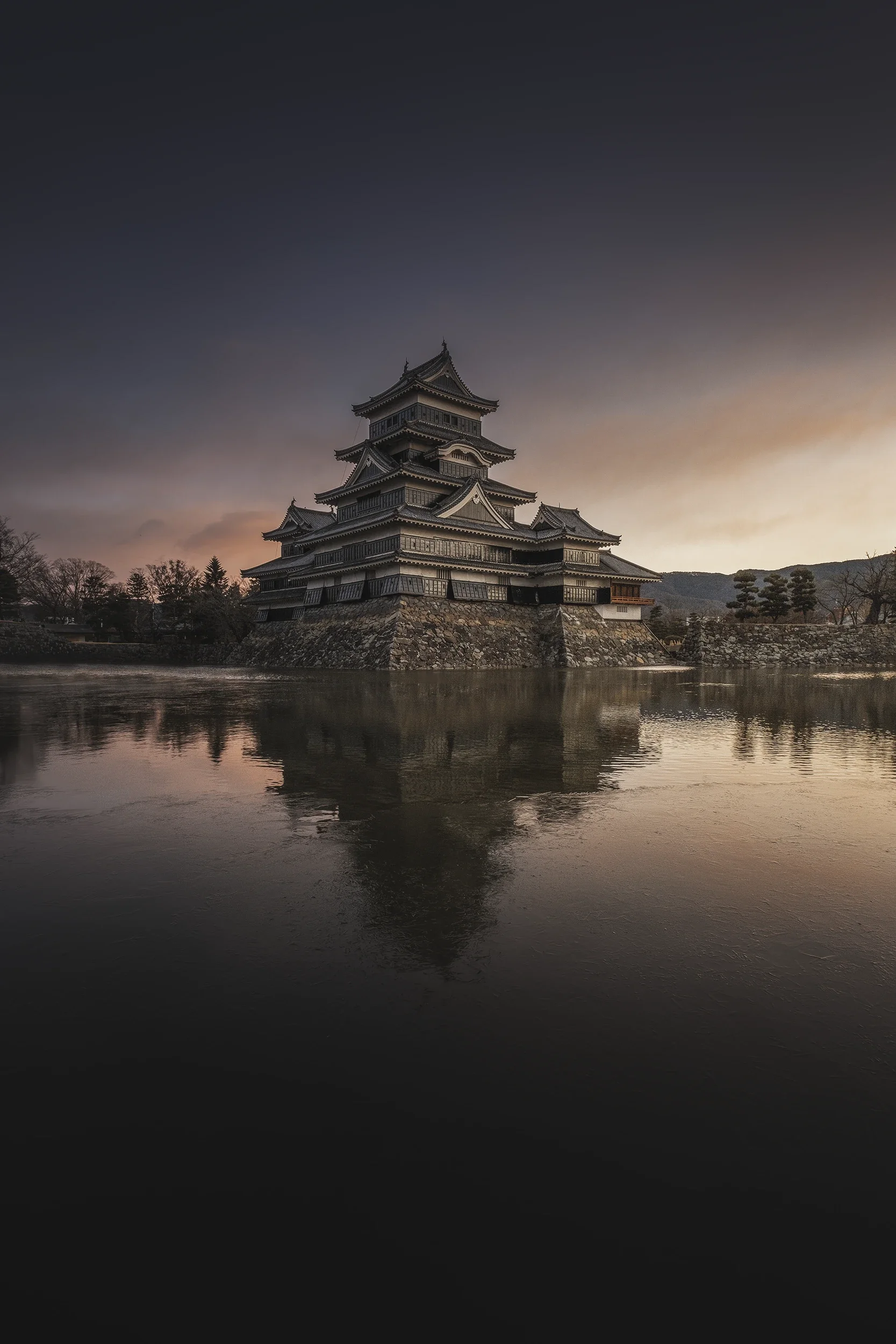
Why Is Matsumoto Castle Black
One of Matsumoto Castle's defining characteristics is its elegant black exterior.
Several theories explain its distinctive appearance. Some historians believe the dark lacquer provided additional protection against weather and moisture, while others suggest the color projected military strength and authority.
Whatever its original purpose, the dramatic contrast between the black walls, white windows, and distant snow-covered mountains creates one of the most photogenic scenes in Japan.
The castle's nickname, Crow Castle, refers to this dark silhouette, in contrast with Himeji Castle, often called the White Heron Castle because of its brilliant white plaster walls.
Inside the Main Keep
Although the exterior appears graceful, the interior reminds visitors that this was once a military fortress.
The six-story wooden keep features steep staircases, narrow corridors, hidden defensive positions, and openings through which defenders could fire arrows or guns at approaching enemies.
Several floors display historical weapons, armor, and firearms that illustrate the rapid evolution of warfare during the late Sengoku period.
From the upper floors, visitors are rewarded with panoramic views over Matsumoto City and the surrounding Japanese Alps.
Centuries of Peace
Following the establishment of the Tokugawa Shogunate in 1603, Japan entered the Edo period, an era of relative peace that lasted more than 260 years.
As large-scale warfare disappeared, castles gradually evolved from military fortresses into administrative and political centers.
Matsumoto Castle became the residence of successive daimyō who governed the surrounding domain on behalf of the shogunate.
Without the constant threat of war, the castle's symbolic importance increasingly outweighed its military role.
Saved from Demolition
Like many Japanese castles, Matsumoto Castle faced an uncertain future after the Meiji Restoration of 1868.
With the abolition of the feudal system, castles across Japan were abandoned, dismantled, or demolished as symbols of the old order.
Matsumoto Castle narrowly escaped destruction thanks to the determination of local citizens, who organized fundraising campaigns to preserve this extraordinary landmark.
Major restoration work carried out throughout the twentieth century ensured the survival of its original wooden structures for future generations.
Today, it stands as one of Japan's five castles designated as National Treasures.
A Living Piece of Japanese History
Walking through Matsumoto Castle offers far more than a simple visit to an old fortress.
Its weathered wooden beams, steep staircases, polished floors, and defensive architecture provide a tangible connection to Japan's feudal past.
Outside, the reflections of the black keep in the surrounding moat change beautifully with each season—from spring cherry blossoms to vibrant autumn foliage and snow-covered winter landscapes.
Few places capture the atmosphere of medieval Japan quite as powerfully.
Visiting Matsumoto Castle Today
Today, Matsumoto Castle remains one of central Japan's most rewarding historical sites.
Its remarkably preserved architecture, dramatic setting, and fascinating history make it an essential destination for anyone interested in Japanese culture, architecture, or samurai history.
Combined with the charming streets of Matsumoto and the spectacular scenery of the Japanese Alps, the castle offers an unforgettable glimpse into one of Japan's most remarkable historical landscapes.
Location:
A short video of Matsumoto Castle