
Amaterasu: The Sun Goddess and the Mythological Origins of Japan
The figure of Amaterasu, the sun goddess, holds a central place in Japanese mythology. Revered as the ancestor of Japan's emperors, her story sheds light on the profound beliefs surrounding the divine origins of the nation. Amaterasu is not only the most venerated solar deity in the Shinto pantheon but also a symbolic figure representing light, royalty, and cosmic order. The connection between the myth of Amaterasu and the imperial lineage continues to play a vital role in contemporary Japanese culture, where mythology and history intertwine to forge a unique national identity.
Amaterasu and the Creation of the World
In Japanese mythological texts, particularly the Kojiki (Records of Ancient Matters) and the Nihon Shoki (Chronicles of Japan), Amaterasu is depicted as the daughter of the creator god Izanagi. After purifying himself from the impurities of the underworld (Yomi), Izanagi gave birth to three main deities, collectively known as the Mihashira no Uzu no Miko. These three children are Amaterasu, the goddess of the sun; Tsukuyomi, the god of the moon; and Susanoo, the god of storms and seas.
Amaterasu was entrusted by Izanagi to govern the Takamagahara, the "High Plain of Heaven," becoming the supreme deity of this celestial realm. Her light was essential to life and harmony in the universe, embodying the very essence of order and divine benevolence. Tsukuyomi, her brother, ruled over the night, while Susanoo, despite his power, was a rebellious and tumultuous god.
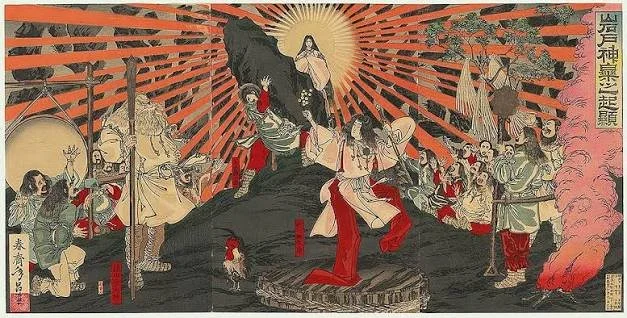
The Myth of the Cave: A Pivotal Moment in Japanese Mythology
One of the most famous episodes involving Amaterasu is the story of the celestial cave, or Ama no Iwato. According to the myth, Susanoo, in a fit of rage, caused chaos and destruction in both heaven and earth. He destroyed rice fields, desecrated sacred places, and hurled impure objects into Amaterasu’s domain, driving her to retreat into a hidden cave. This withdrawal deprived the world of her light.
Amaterasu’s absence plunged the world into total darkness. Without sunlight, crops withered, gods were powerless, and chaos reigned. Desperate, the other deities gathered to devise a plan to lure her out of the cave. They organized a series of rituals, dancing and singing before the cave to catch her attention.
The intervention of Ame-no-Uzume, the goddess of dawn, was key to their success. Using a clever trick involving a mirror, the gods managed to intrigue Amaterasu. When she peeked out and saw her own radiant reflection in the mirror, she was fascinated, and the gods quickly sealed the cave’s entrance behind her. Thus, sunlight was restored, and harmony returned to the world.
The Divine Lineage and the Japanese Emperor
A fundamental aspect of Amaterasu’s myth is her connection to the Japanese imperial family. According to mythological accounts, Jimmu Tennō, the legendary first emperor of Japan, is a direct descendant of Amaterasu. This divine lineage has legitimized the emperor's status as a sacred representative on Earth for centuries.
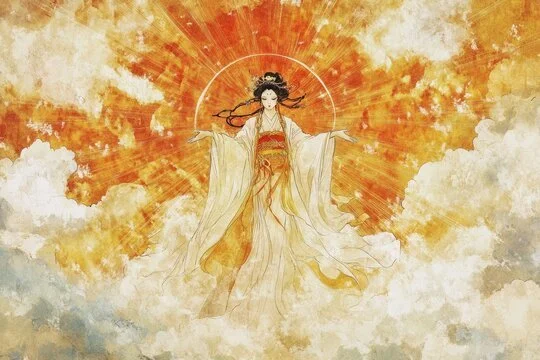
The transfer of celestial power to humanity occurs through the mission of Ninigi-no-Mikoto, Amaterasu’s grandson, who was sent to Earth to govern the terrestrial Takamagahara—Japan. Before his descent, Amaterasu entrusted him with three sacred treasures, known as the Sanshu no Jingi: the sacred mirror (Yata no Kagami), the curved jewel (Yasakani no Magatama), and the legendary sword (Kusanagi no Tsurugi). These objects symbolize the legitimacy and continuity of imperial power and are preserved today as sacred treasures of the imperial family.
Every Japanese emperor is considered a descendant of Amaterasu, granting the imperial institution both religious and political significance. The connection between the emperor and the sun goddess has solidified the imperial family's central role in Japanese unity and supported the belief that the emperor mediates between gods and humans.
What Amaterasu Represents in Japanese Culture
Amaterasu is far more than a figure in Japanese mythology; she embodies fundamental concepts of Japanese culture and spirituality. As the sun goddess, she represents light, which is essential not only for physical life (agriculture, prosperity) but also for spiritual purity and order. In Shinto philosophy, the idea of purity is crucial, and Amaterasu’s brilliance sustains this purity against chaotic forces symbolized by Susanoo.
She is also a symbol of political stability and legitimacy. The emperor, as a descendant of Amaterasu, draws divine legitimacy from this mythological connection. Over centuries, the relationship between the emperor and Amaterasu has been used to justify the continuity and supremacy of the imperial dynasty, considered the oldest uninterrupted ruling dynasty in the world.
Furthermore, Amaterasu symbolizes national unity. As the solar deity, she illuminates not only the heavens but also the entire Japanese archipelago, symbolically uniting the islands under her light. Her role as Japan's protector and source of light makes her a universal figure, bringing the Japanese people together in their cultural identity.
Amaterasu in Rituals and Tradition
The Ise Grand Shrine, located in Mie Prefecture, is the most sacred site dedicated to Amaterasu. This shrine, which dates back thousands of years, serves as the center of imperial worship and Shintoism. Every reigning emperor participates in the rituals at the Ise Shrine, symbolizing the spiritual bond between the imperial family and the sun goddess.
One of the most significant events related to Amaterasu is the imperial accession ritual. During this ceremony, the newly crowned emperor is symbolically united with the sun goddess to receive her blessing and affirm his position as the rightful heir to the throne. This ritual reinforces the notion that the emperor's authority is divinely ordained, passed down through generations from Amaterasu herself.
Amaterasu and Modernity
Today, although Japan is a modern democracy, the myths surrounding Amaterasu continue to hold a place in the collective imagination of the nation. The symbolic status of the emperor has evolved, especially after World War II, when Emperor Hirohito renounced his divine status. However, the mythological link between the emperor and Amaterasu remains evident in rituals and traditions, albeit with more cultural than political significance.
Amaterasu also appears prominently in modern popular culture, including films, anime series, and video games, highlighting the enduring impact of this ancient myth on Japan's cultural identity.
Conclusion
The myth of Amaterasu, the sun goddess and ancestor of Japan’s emperors, is one of the foundational narratives of Japanese culture and history. Through her role as the protector of light and purity, she symbolizes order, legitimacy, and national unity. Her relationship with the imperial lineage has shaped the idea of a divinely blessed Japan, where the emperor embodies harmony between the celestial and terrestrial worlds. This connection between myth and historical reality continues to influence how the Japanese perceive their past and identity. In a nation where tradition and modernity coexist, Amaterasu remains a powerful and unifying figure.